
Gandhi Jayanti 2026: History, Significance, Mahatma Gandhi’s Teachings and Importance
Gandhi Jayanti 2026: Gandhi Jayanti is observed every year on 2 October to commemorate the birth anniversary of Mahatma Gandhi, one of the leading figures of India’s freedom movement and a globally recognised advocate of non-violence. In 2026, Gandhi Jayanti will be observed on Friday, 2 October.
The day is remembered for Gandhi’s principles of truth, non-violence, simplicity, peace and social harmony. The United Nations also observes 2 October as the International Day of Non-Violence, following a UN General Assembly resolution adopted in 2007.
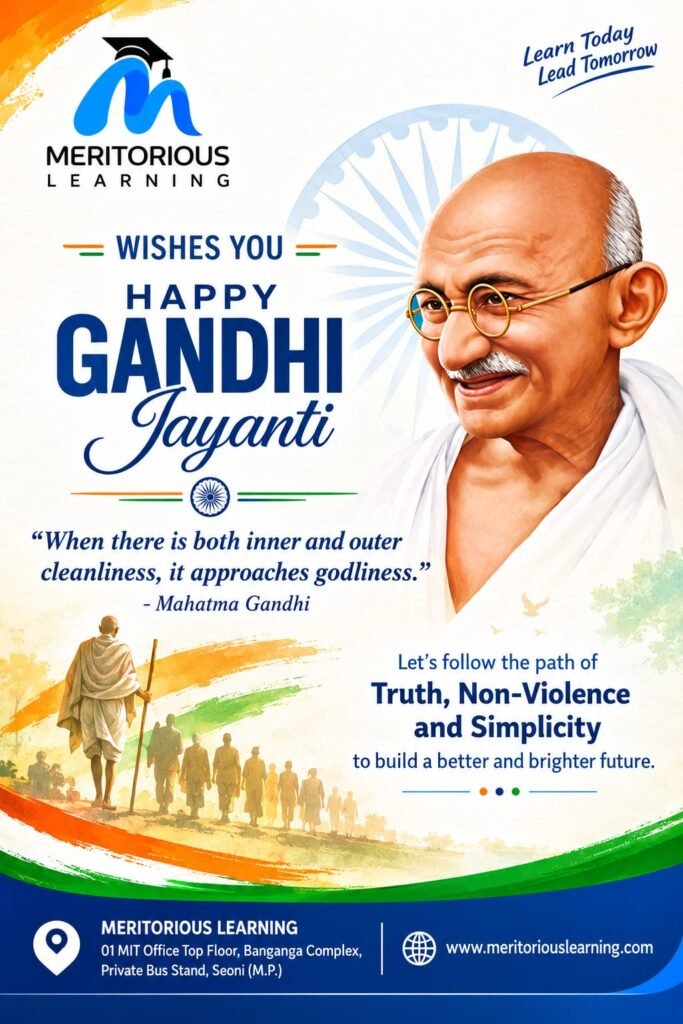
Gandhi Jayanti 2026 – Overview
| Particular | Details |
|---|---|
| Event | Gandhi Jayanti |
| Date | 2 October 2026 |
| Day | Friday |
| Occasion | Birth Anniversary of Mahatma Gandhi |
| Born | 2 October 1869 |
| Birthplace | Porbandar, Gujarat |
| Known For | Non-violent resistance and India’s freedom movement |
| International Observance | International Day of Non-Violence |
| Observed By | India and the international community |
Why is Gandhi Jayanti Celebrated?
Gandhi Jayanti is celebrated to remember the life and contributions of Mahatma Gandhi, particularly his emphasis on truth, non-violence and peaceful resistance.
The United Nations describes Gandhi as a leader of India’s independence movement and a pioneer of the philosophy and strategy of non-violence. His approach to non-violent resistance later became an inspiration for civil rights and social-change movements in different parts of the world.
The day also provides an opportunity to reflect on values such as:
- Truth and honesty
- Non-violence
- Peace and tolerance
- Simplicity
- Self-discipline
- Social responsibility
- Respect for others
Mahatma Gandhi: Early Life
Mohandas Karamchand Gandhi, popularly known as Mahatma Gandhi, was born on 2 October 1869 in Porbandar, Gujarat.
He studied law in England and later worked in South Africa, where his experiences with racial discrimination played an important role in shaping his methods of peaceful resistance.
After returning to India, Gandhi became an important figure in the country’s freedom movement. His campaigns promoted mass participation and non-violent resistance against British colonial rule.
Gandhi and the Principle of Non-Violence
Non-violence, or Ahimsa, became one of the central principles associated with Gandhi’s public life.
Gandhi believed that social and political change could be pursued through peaceful methods rather than physical violence. His approach included methods such as peaceful protest, civil disobedience and non-cooperation.
The Salt March of 1930 is one of the best-known examples of his use of non-violent civil resistance. The United Nations highlights the Salt March as part of Gandhi’s wider strategy of civil disobedience.
Gandhi Jayanti as International Day of Non-Violence
Gandhi Jayanti has significance beyond India.
The United Nations General Assembly adopted Resolution A/RES/61/271 in 2007, establishing 2 October as the International Day of Non-Violence. The day aims to spread awareness about non-violence through education and public awareness and to promote a culture of peace, tolerance and understanding.
Thus, 2 October is observed both as Gandhi Jayanti in India and as the International Day of Non-Violence internationally.
Gandhi’s Important Teachings
Gandhi’s life is often associated with several principles that continue to be discussed in education and public life.
1. Truth
Truth, or Satya, was central to Gandhi’s philosophy. He emphasised honesty and integrity in personal and public life.
2. Non-Violence
Ahimsa was an important part of his approach to social and political change.
3. Simplicity
Gandhi promoted a simple lifestyle and emphasised self-discipline and responsible consumption.
4. Peaceful Resistance
His methods demonstrated how people could participate in collective action without relying on physical violence.
5. Social Responsibility
Gandhi also focused on cleanliness, community welfare, dignity of labour and social harmony.
How is Gandhi Jayanti Celebrated?
Gandhi Jayanti is observed through various educational and public programmes across India.
Common activities include:
- Prayer meetings
- Tributes at Gandhi memorials
- Cleanliness and sanitation drives
- Essay and speech competitions
- Drawing and poster competitions
- School and college programmes
- Discussions on peace and non-violence
- Community service activities
- Awareness programmes
The occasion is particularly relevant for students because it provides an opportunity to learn about Gandhi’s life, India’s freedom movement and the principles of peaceful social change.
Gandhi Jayanti 2026: Message for Students
Gandhi Jayanti is not only a day to remember a historical personality but also an opportunity to understand values such as truth, discipline, kindness, peaceful communication and respect for others.
Students can observe the day by practising these values in their daily lives—being honest, respecting others, avoiding unnecessary conflict and contributing positively to their school and community.
Gandhi Jayanti Quote
“Non-violence is a weapon of the strong.”
This quotation is listed among Gandhi’s statements on non-violence by the United Nations.