
Indian Parliament: Structure, Composition, and Functions Under Article 79
India is the world’s largest democracy, and its parliamentary system forms the backbone of the country’s governance. The Parliament of India, established under Article 79 of the Constitution, is the supreme legislative body responsible for making laws, debating national issues, and ensuring government accountability.
According to Article 79, the Parliament consists of three components:
The President of India
The Lok Sabha (House of the People)
The Rajya Sabha (Council of States)
Together, these institutions play a vital role in maintaining India’s democratic framework.
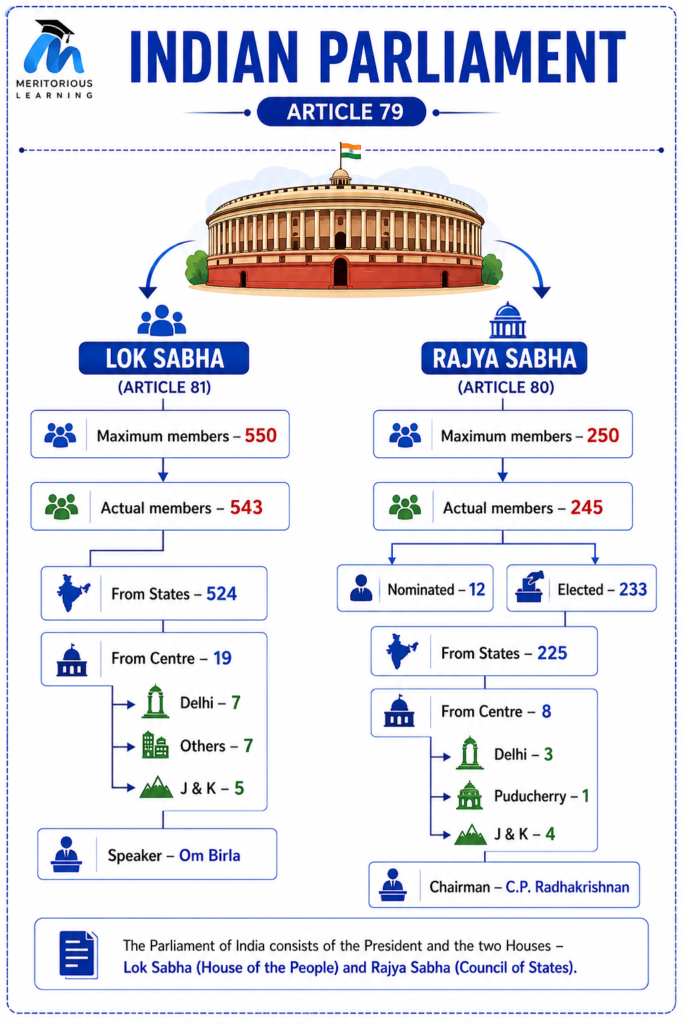
Structure of the Indian Parliament
1. Lok Sabha (House of the People) – Article 81
The Lok Sabha is the lower house of Parliament and represents the citizens of India. Members of the Lok Sabha are directly elected by the people through general elections.
Key Facts About Lok Sabha
Maximum Strength: 550 members
Current Strength: 543 members
Members are elected from constituencies across India.
Term of Office: 5 years
Presiding Officer: Speaker of the Lok Sabha
Functions of Lok Sabha
Passes laws and legislation.
Controls government finances and approves the Union Budget.
Discusses national issues and policies.
Holds the government accountable through debates and questioning.
2. Rajya Sabha (Council of States) – Article 80
The Rajya Sabha is the upper house of Parliament and represents the states and union territories of India.
Key Facts About Rajya Sabha
Maximum Strength: 250 members
Current Strength: 245 members
Up to 12 members can be nominated by the President for their contributions to literature, science, art, and social service.
Remaining members are elected by State Legislative Assemblies.
It is a permanent house and cannot be dissolved.
One-third of its members retire every two years.
Presiding Officer: Vice President of India (Chairman of Rajya Sabha)
Functions of Rajya Sabha
Reviews and debates legislation passed by the Lok Sabha.
Represents the interests of states.
Participates in constitutional amendments.
Acts as a revising chamber for proposed laws.
Role of the President in Parliament
Although the President is not a member of either House, the Constitution considers the President an integral part of Parliament.
Powers of the President
Summons and prorogues Parliament sessions.
Addresses Parliament at the beginning of the first session each year.
Gives assent to bills passed by both Houses.
Can return certain bills for reconsideration.
Has the authority to dissolve the Lok Sabha.
Without the President’s approval, a bill cannot become law.
Importance of the Indian Parliament
The Parliament serves as the foundation of India’s democratic governance. It:
- Makes and amends laws.
- Represents the people and states.
- Controls public finances.
- Ensures transparency and accountability in government.
- Protects constitutional values and democratic principles.
The Indian Parliament, established under Article 79, consists of the President, Lok Sabha, and Rajya Sabha. While the Lok Sabha represents the people of India, the Rajya Sabha represents the states. Together, they create a balanced legislative system that ensures democratic governance, lawmaking, and accountability in the country.